
Manulife Canadian Core Equity
Mandate commentary
Q2 2026
Highlights
① The mandate returned 6.45%, underperforming the S&P/TSX Composite Index by 0.51 percentage points, as a modest shortfall in Financials partly offset the benefit from an underweight allocation to Materials.
② Earnings strength helped markets absorb uncertainty.
③ Valuations and rates make selectivity more important.
Mandate overview
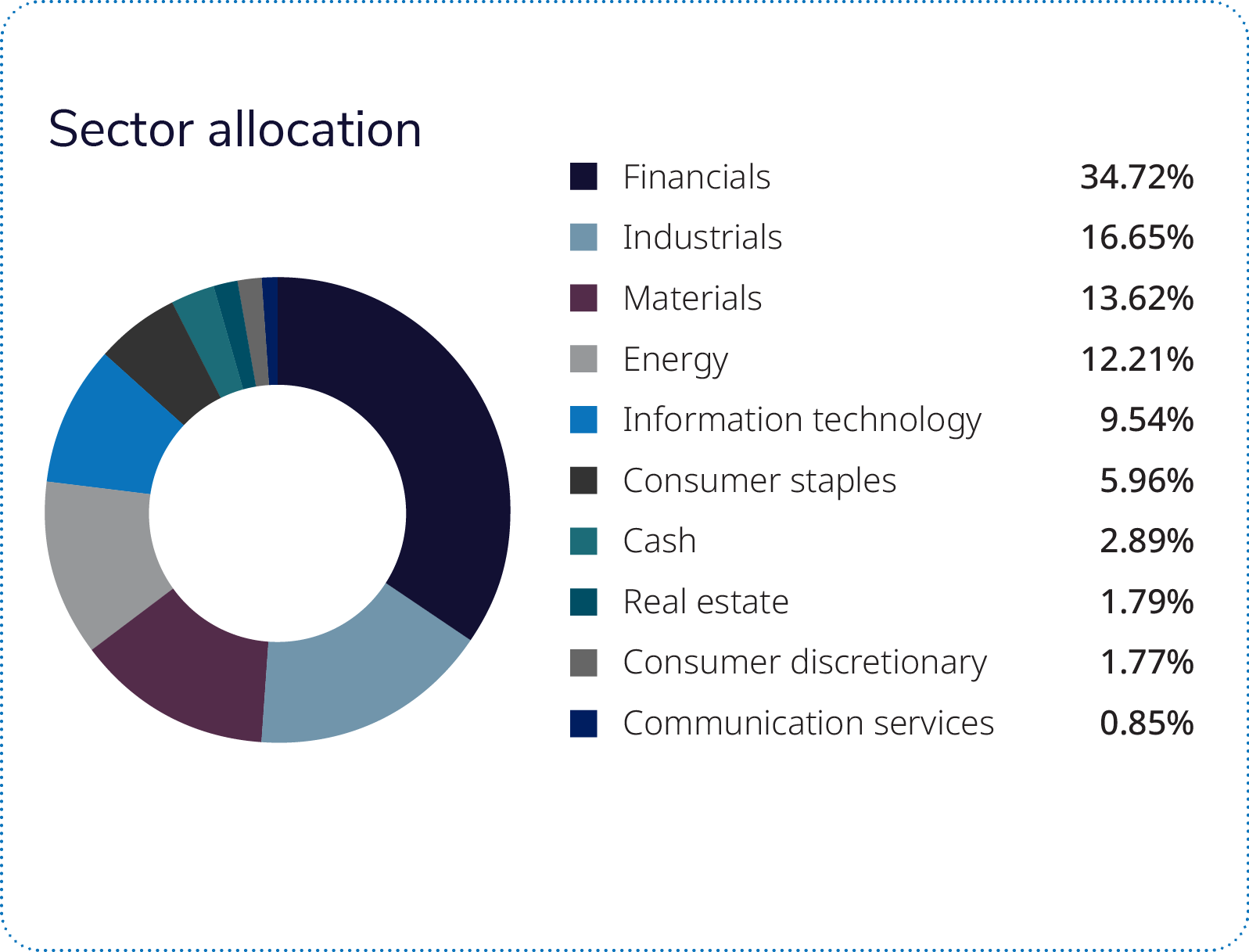 Canadian equities advanced during the second quarter, with the S&P/TSX Composite Index reaching a record high in June. Financials led the market, supported by strong earnings, robust capital-markets activity and improving fundamentals, while health care and industrials also advanced. In contrast, materials, communication services and energy declined as easing tensions in the Middle East weighed on oil prices and lower gold prices pressured mining companies.
Within financials, the portfolio modestly lagged the sector, detracting from relative performance, primarily due to a small underweight allocation to Canadian banks.
Conversely, the portfolio’s underweight allocation to materials, particularly gold companies, contributed positively as the sector declined. Gold was the second-weakest-performing sub-industry during the quarter, returning approximately -16%, as exchange-traded fund flows reversed from their February highs and weighed on gold prices.
Mandate: Manulife Canadian Core Equity SMA stock review
Performance contributors
Toronto-Dominion Bank was a top contributor. The portfolio maintained an average overweight position of 2.8% during the quarter, and the company returned 34%, outperforming the financials sector. Performance was supported by strong year-over-year earnings-per-share growth and an aggressive share-repurchase program.
Royal Bank of Canada returned 31% during the quarter. The company reported adjusted earnings of $5.6 billion, supported by record net income in capital markets and continued asset growth in wealth management.
Performance detractors
Canadian Natural Resources detracted as easing tensions in the Middle East and prospects for a U.S.-Iran peace agreement weighed on oil prices and the broader energy sector. Geopolitical and market uncertainty also affected investor sentiment toward the company.
Agnico Eagle Mines also detracted, as lower gold prices weighed on precious-metals equities. A rock-mass movement at the Barnat open pit at Canadian Malartic led to a temporary suspension of mining operations and reduced production guidance for 2026 and subsequent years, further pressuring the company’s shares.
Total gross returns:
Total return (CAD) | QTD | YTD | 1YR | 3YR | 5YR | SINCE INC. (FEB. 18, 2025) |
MANULIFE CANADIAN CORE EQUITY | 6.45
| 11.27
| 22.91
| 23.19
|
Mandate repositioning
During the quarter, the mandate made targeted adjustments to reflect evolving market conditions. Exposure to communication services was reduced due to limited upside potential, while exposure to gold companies was trimmed. Within financials, bank holdings were reduced following strong performance and higher valuations, with capital redeployed to a data provider and exchange operator.
Within industrials, the mandate initiated a position in a business-jet manufacturer based on improving fundamentals. It also trimmed transportation companies and large equipment retailers following strong performance and exited an engineering and construction company with exposure to nuclear power.
The mandate also initiated a position in a logistics-focused software company, reflecting the view that the AI-related selloff had disproportionately affected its share price. These changes position the portfolio toward areas offering more attractive opportunities while continuing to manage risk as the macroeconomic environment evolves.
Market overview: earnings strength helped markets absorb uncertainty
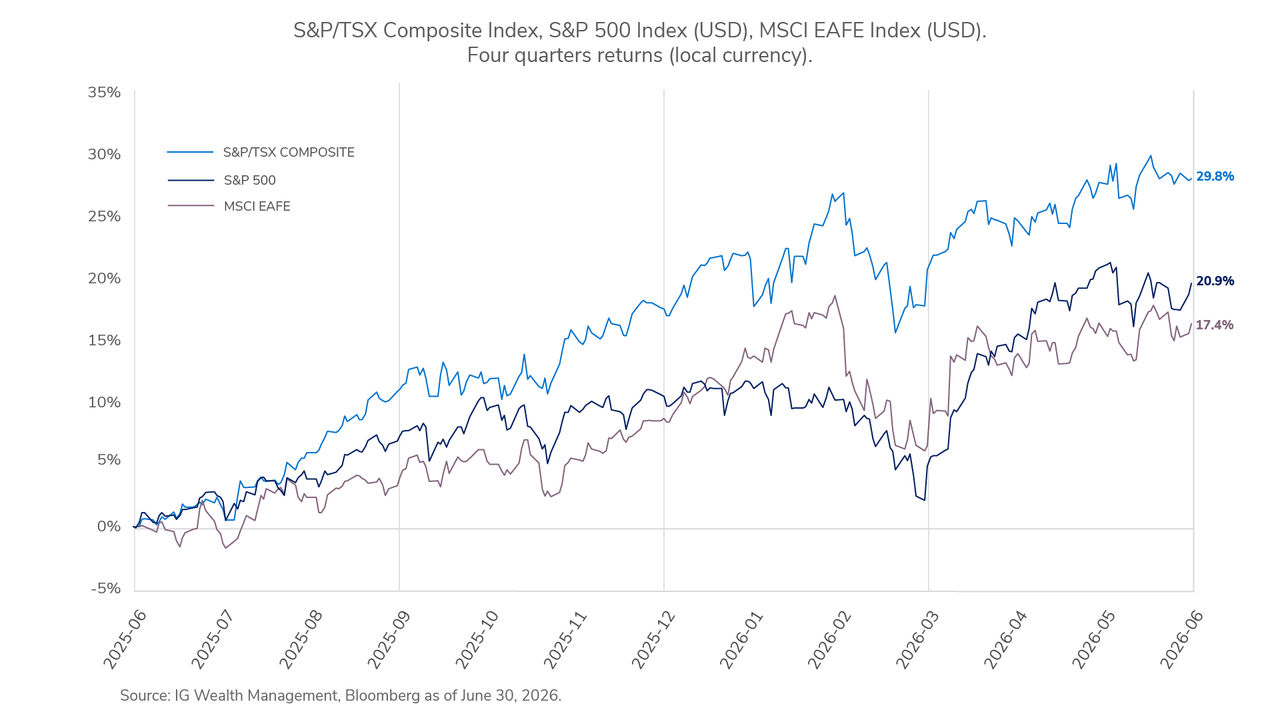
The second quarter of 2026 reinforced the resilience of financial markets. Investors faced conflict in the Middle East, commodity-price volatility, shifting interest-rate expectations and renewed inflation concerns, yet global equities continued to advance as corporate earnings and economic activity remained stronger than expected. The S&P 500 gained 14.9% in U.S.-dollar terms for the quarter, while the S&P/TSX Composite Index advanced 6.4%, supported by healthier earnings expectations and improving market breadth.
Canadian equities were led by a strong rebound in financials, as better-than-expected bank earnings, resilient credit quality and improved capital markets activity lifted sentiment. U.S. equities were supported by earnings strength rather than a simple risk-on rally, with Information Technology leading as AI infrastructure spending continued to anchor sentiment. International equities also contributed meaningfully, with emerging markets Korea and Taiwan benefitting from demand across the global technology supply chain.
Market outlook: valuations and rates make selectivity more important
Markets enter the second half of 2026 with fundamentals remaining broadly supportive, although elevated equity valuations leave less room for error. Earnings growth is likely to remain the key driver of returns, while inflation trends, central bank policy and interest-rate expectations will continue to shape market sentiment.
Across asset classes, diversification remains important. Canadian, international and emerging market equities offer exposure to distinct sources of growth, while higher yields in fixed income continue to provide a cushion against volatility. Selectivity remains key as investors balance opportunities against valuation and policy risks.
To discuss your investment strategy, speak to your IG Advisor.
Azure Managed Investments™ provides discretionary investment management services distributed by IG Wealth Management Inc., Investment dealer. We will manage your Azure Managed Investments Accounts on a segregated basis in accordance with your investment policy statement and the resulting mandate selected by you. Mandates will be managed by I.G. Investment Management, Ltd. and partner organizations. You are required to make a minimum initial investment of $150,000; please read the Azure Managed Investment Account Agreement for complete details, including fees and expenses.
This commentary may contain forward-looking information, which reflects our or third-party current expectations or forecasts of future events. Forward-looking information is inherently subject to, among other things, risks, uncertainties and assumptions that could cause actual results to differ materially from those expressed herein. These risks, uncertainties and assumptions include, without limitation, general economic, political and market factors, interest and foreign exchange rates, the volatility of equity and capital markets, business competition, technological change, changes in government regulations, changes in tax laws, unexpected judicial or regulatory proceedings and catastrophic events. Please consider these and other factors carefully and do not place undue reliance on forward-looking information. The forward-looking information contained herein is current only as of June 30, 2026. There should be no expectation that such information will in all circumstances be updated, supplemented or revised, whether as a result of new information, changing circumstances, future events or otherwise.
This commentary is published by IG Wealth Management. It is provided as a general source of information. It is not intended to provide investment advice or as an endorsement of any investment. Some of the securities mentioned may be owned by IG Wealth Management or its mutual funds, or by portfolios managed by our external advisors. It may contain certain forward-looking statements regarding the market conditions which are based upon assumptions believed to be reasonable at the time of publishing. Every effort has been made to ensure that the material contained in the commentary is accurate at the time of publication, however, IG Wealth Management cannot guarantee the accuracy or the completeness of such material and accepts no responsibility for any loss arising from any use of or reliance on the information contained herein.
Past performance may not be repeated and is not indicative of future results. Actual performance may vary due to a range of factors including but not limited to current market conditions, timing of contributions and withdrawals, client-imposed restrictions, fees, expenses, tax considerations and other individual circumstances. There are no assurances that any mandate will achieve its objectives and/or avoid any losses.
Trademarks, including IG Wealth Management and IG Private Wealth Management, are owned by IGM Financial Inc. and licensed to subsidiary corporations.
©2026 IGWM Inc.