Portfolio returns: Q2 2026
| Total Return | 1M | 3M | YTD | 1YR | 3YR | 5YR | 10YR | Since Inc. July 12, 2013 |
IG Core Portfolio – Income Plus F | 0.92
| 5.93
| 5.87
| 12.11
| 9.83
| 4.98
| 4.80
| 4.86
|
Quartile rankings | 2 | 1 | 1 | 1 | 1 | 1 | 1 |

| Total Return | 1M | 3M | YTD | 1YR | 3YR | 5YR | 10YR | Since Inc. July 12, 2013 |
IG Core Portfolio – Income Plus F | 0.92
| 5.93
| 5.87
| 12.11
| 9.83
| 4.98
| 4.80
| 4.86
|
Quartile rankings | 2 | 1 | 1 | 1 | 1 | 1 | 1 |
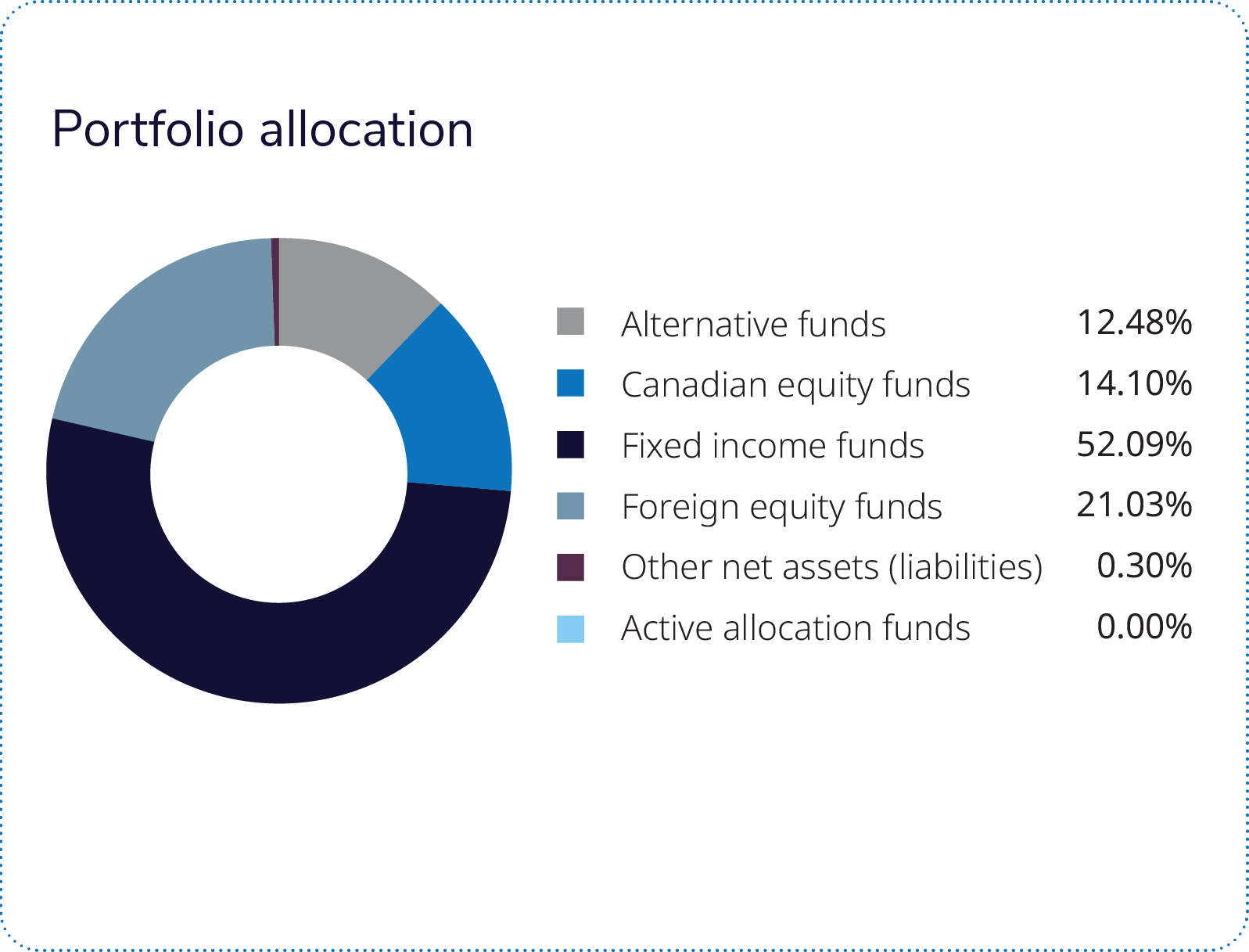 Global equities surged in the second quarter, driven by the AI infrastructure boom and de-escalating geopolitical tensions. Emerging and developed markets saw gains, propelled by Information Technology, particularly semiconductors. Canadian equities lagged global peers; however, strong financial sector performance offset declines in Energy and Materials. A stronger U.S. dollar made U.S. assets more attractive for Canadian investors. Globally, growth outperformed value.
Commodity markets reversed as geopolitical risk premiums faded. Oil plunged as Middle East conflicts de-escalated, easing supply fears. Gold and Bitcoin also suffered pullbacks, losing support amid sticky inflation and hawkish central bank outlooks.
Fixed income saw modest returns amid shifting monetary policy. Core government bonds were flat as the U.S. Federal Reserve’s hawkish tone on persistent inflation prompted markets to reprice expectations toward potential rate hikes. Despite these duration headwinds, credit markets outperformed core government debt, benefitting from tightening corporate spreads and resilient earnings.
The IG Core Portfolio - Income Plus generated a positive return for the quarter, driven by strong performance from liquid alternatives and Canadian equities.
The largest contributors to performance were the Mackenzie Broad Risk Premia Collection Fund, Mackenzie Canadian Equity Pool and the Mackenzie IG Canadian Bond Pool. The Mackenzie Broad Risk Premia Collection Fund, an alternative strategy combining equity exposure with multiple alternative strategies in a capital efficient manner, benefitted from U.S. equity sector and FX timing strategies. The Mackenzie Canadian Equity Pool delivered positive returns and outperformed its benchmark, driven by an underweight allocation to materials and strong security selection within Financials, though an overweight allocation to Energy slightly detracted. The Mackenzie IG Canadian Bond Pool also added value, outperforming its benchmark due to strong government bond selection, despite some detraction from duration management.
The Mackenzie Enhanced Fixed Income Risk Premia Fund, a levered alternative fixed income fund used to efficiently manage total portfolio exposure, was the sole detractor. Increasing bond yields led to falling bond prices, pressuring fixed income returns. The IG Mackenzie Real Property Fund generated positive returns but was among the weaker contributors. Its performance was primarily driven by the stabilization of office property operations and market valuations, supported by steady income and strong occupancy levels across its retail, industrial and multifamily properties.
The second quarter of 2026 reinforced the resilience of financial markets. Investors faced conflict in the Middle East, commodity-price volatility, shifting interest-rate expectations and renewed inflation concerns, yet global equities continued to advance as corporate earnings and economic activity remained stronger than expected. The S&P 500 gained 14.9% in U.S.-dollar terms for the quarter, while the S&P/TSX Composite Index advanced 6.4%, supported by healthier earnings expectations and improving market breadth.
Canadian equities were led by a strong rebound in financials, as better-than-expected bank earnings, resilient credit quality and improved capital markets activity lifted sentiment. U.S. equities were supported by earnings strength rather than a simple risk-on rally, with Information Technology leading as AI infrastructure spending continued to anchor sentiment. International equities also contributed meaningfully, with emerging markets Korea and Taiwan benefitting from demand across the global technology supply chain.
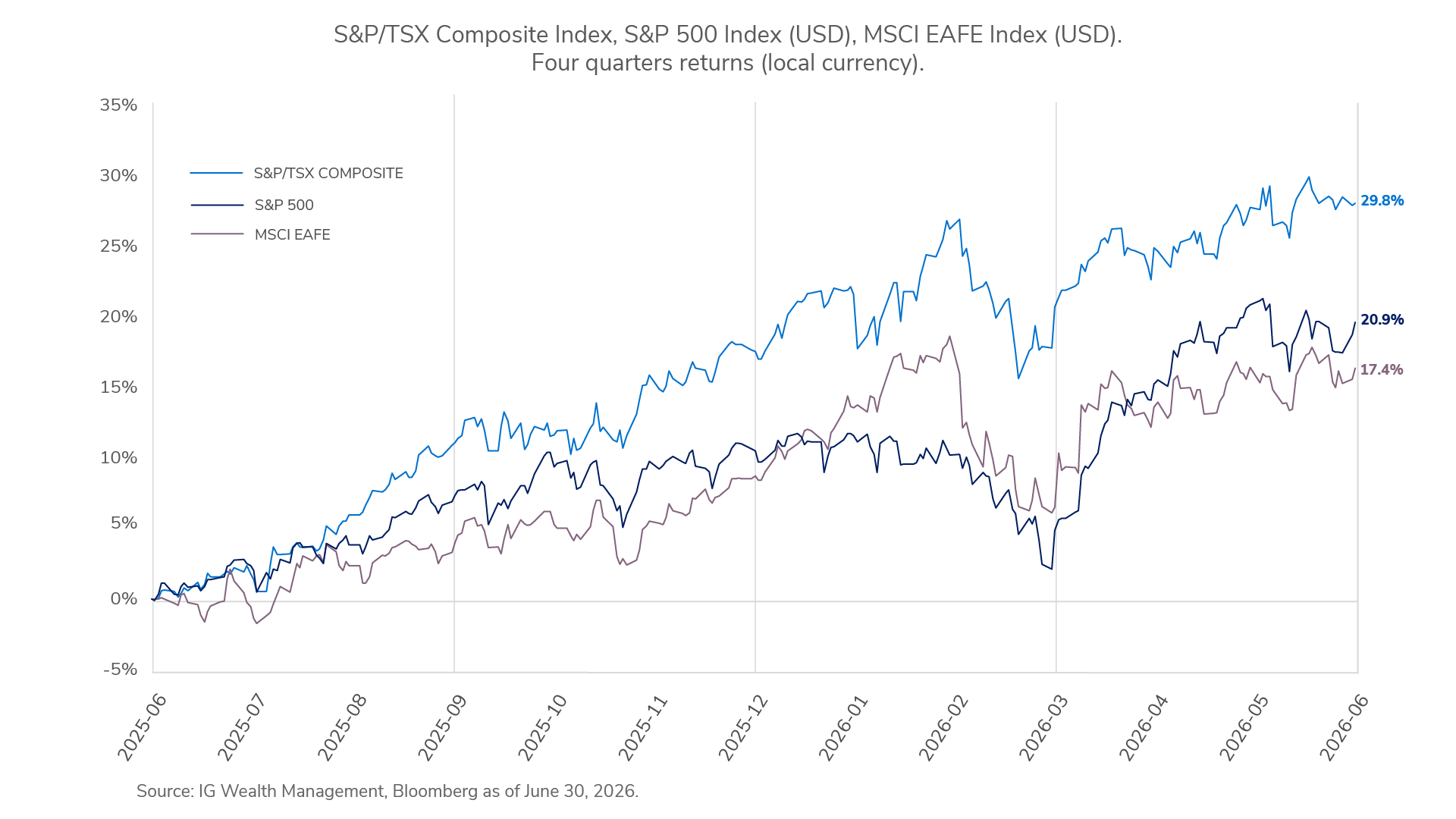
Our outlook for equities remains neutral. While the fundamental backdrop of the economy and corporate earnings remains strong, we are cautious of stretched retail investor positioning, which increases the vulnerability to sharp market selloffs. From a relative standpoint, we favour U.S. small caps over Canadian equities. The robust U.S. economy continues to support U.S. small caps, which have remained undervalued for a prolonged period. In contrast, recent Canadian economic data has shown notable weakness. Additionally, we have closed our underweight position in European equities as the region's economic data has begun to improve.
In fixed income, we maintain a neutral duration stance. Aggressive inflation-fighting rhetoric from the new Federal Reserve Chair has triggered a flattening of the yield curve, driving short-term yields higher as additional rate hikes are priced in, while long-term yields have declined on lower long-term inflation expectations. This unique curve dynamic, combined with persistently strong U.S. economic data, reinforces our measured and balanced approach to bond positioning.
Commissions, fees and expenses may be associated with mutual fund investments. Read the prospectus and speak to an IG Advisor before investing. The rate of return is the historical annual compounded total return as of June 30, 2026, including changes in value and reinvestment of all dividends or distributions. It does not take into account sales, redemption, distribution, optional charges or income taxes payable by any securityholder that would have reduced returns. Mutual funds are not guaranteed, values change frequently and past performance may not be repeated. Mutual funds and investment products and services are offered through the Mutual Fund Division of IG Wealth Management Inc. (in Quebec, a firm in financial planning). And additional investment products and brokerage services are offered through the Investment Dealer, IG Wealth Management Inc. (in Quebec, a firm in financial planning), a member of the Canadian Investor Protection Fund.
This commentary may contain forward-looking information which reflects our or third-party current expectations or forecasts of future events. Forward-looking information is inherently subject to, among other things, risks, uncertainties and assumptions that could cause actual results to differ materially from those expressed herein. These risks, uncertainties and assumptions include, without limitation, general economic, political and market factors, interest and foreign exchange rates, the volatility of equity and capital markets, business competition, technological change, changes in government regulations, changes in tax laws, unexpected judicial or regulatory proceedings and catastrophic events. Please consider these and other factors carefully and do not place undue reliance on forward-looking information. The forward-looking information contained herein is current only as of June 30, 2026. There should be no expectation that such information will in all circumstances be updated, supplemented or revised whether as a result of new information, changing circumstances, future events or otherwise.
This commentary is published by IG Wealth Management. It represents the views of our Portfolio Managers and is provided as a general source of information. It is not intended to provide investment advice or as an endorsement of any investment. Some of the securities mentioned may be owned by IG Wealth Management or its mutual funds, or by portfolios managed by our external advisors. Every effort has been made to ensure that the material contained in the commentary is accurate at the time of publication, however, IG Wealth Management cannot guarantee the accuracy or the completeness of such material and accepts no responsibility for any loss arising from any use of or reliance on the information contained herein.
Trademarks, including IG Wealth Management and IG Private Wealth Management, are owned by IGM Financial Inc. and licensed to subsidiary corporations.
©2026 IGWM Inc.